نقش دستیار هوش مصنوعی در رفتار نوآورانه کارکنان دانشی (مورد مطالعه: شرکت عامراندیش هوشمند)

نوع مقاله : مقاله پژوهشی با اصالت

نویسندگان

1 استادیار، گروه مدیریت صنعتی عملکرد، دانشکده مدیریت و برنامه ریزی راهبردی، دانشگاه جامع امام حسین (ع)، تهران، ایران، yaserghn@gmail.com

2 دانشجوی کارشناسی ارشد حسابداری، دانشکده مدیریت و حسابداری، پردیس فارابی دانشگاه تهران، قم، ایران، abolfazlghanbari342@gmai.com

3 استادیار، گروه مدیریت بازرگانی، دانشکده علوم اقتصادی و اداری، دانشگاه قم، قم، ایران، Javaheri1390@gmail.com

10.47176/SMOK.2026.1988

چکیده

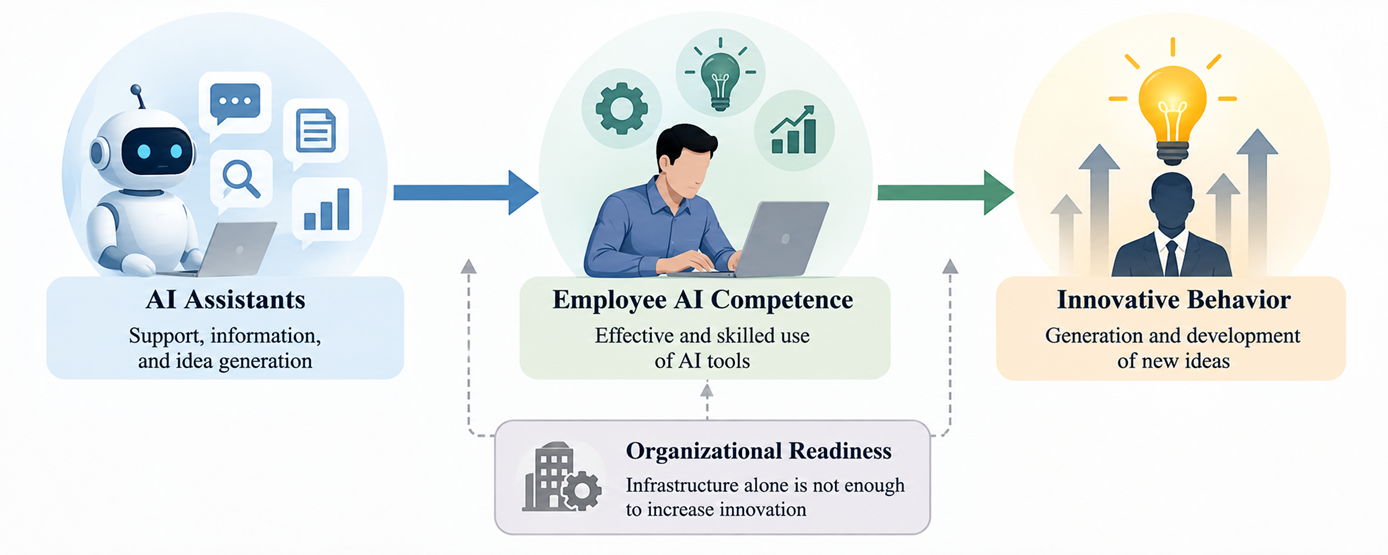
هدف: این پژوهش با هدف بررسی تأثیر دستیارهای هوش مصنوعی بر رفتار نوآورانه کارکنان شرکت عامر اندیش هوشمند، با در نظر گرفتن نقش میانجی شایستگی‌های هوش مصنوعی و نقش تعدیل‌گر آمادگی سازمانی انجام شد.
روش پژوهش: تحقیق با رویکرد اثبات گرایانه علی- مقایسه ایی و  از نوع کاربردی است و جامعه آماری آن کارکنان شرکت دانش بنیان عامر اندیش هوشمند بود که با روش نمونه‌گیری تصادفی در دسترس و با استفاده از فرمول کوکران، 140 نفر به‌عنوان نمونه انتخاب شدند. داده‌های گردآوری شده با نرم‌افزارهای SPSS 27 و SmartPLS  تحلیل شدند.
یافته‌ها: یافته های پژوهش نشان می دهد که دستیارهای هوش مصنوعی تأثیر مثبت و معناداری بر رفتار نوآورانه کارکنان دارند. همچینین شایستگی‌های هوش مصنوعی نیز به‌عنوان متغیر میانجی، تائید گردید. با این حال، نقش تعدیل‌گر آمادگی سازمانی تأیید نشد، که می‌تواند به محدودیت‌های زیرساختی یا فرهنگی سازمان مربوط باشد.
بحث: اثرگذاری دستیارهای هوش مصنوعی بر رفتار نوآورانه، بیش از برخورداری از زیرساخت‌های سازمانی، به توانایی کارکنان در استفاده مؤثر از این ابزارها وابسته است.
نتیجه‌گیری: با توجه به اینکه یافته‌های تحقیق  مبنی میانجی بودن شایستگی‌های هوش مصنوعی در رابطه بین دستیار هوش مصنوعی و رفتار نوآورانه  است ، شرکت ها می بایست به‌جای صرفاً خرید یا  استقرار ابزارهای هوش مصنوعی، تمرکز اصلی خود را بر ایجاد شایستگی‌های هوش مصنوعی قرار دهند. 

کلیدواژه‌ها

موضوعات


عنوان مقاله [English]

The role of artificial intelligence assistants in the innovative behavior of knowledge workers: A case study of Amerandish hooshmand company

نویسندگان [English]

  • Yaser Ghasemnejad 1
  • Mahan Jafarabadi 2
  • Abolfazl Ghanbari 2
  • Ebrahim Javaheri Zadeh 3
1 Assistant Professor, Faculty of Management and Strategic Planning, Imam Hussein Comprehensive University, Iran, yaserghn@gmail.com
2 Master's Student, Faculty of Management, Islamic Azad University, Iran, jafarabadi1378mahan@gmail.com
3 Assistant Professor, Faculty of Economics and Administrative Sciences, University of Qom, Iran, Javaheri1390@gmail.com Corresponding author: Javaheri1390@gmail.com
چکیده [English]

Purpose: this study was conducted to examine the effect of artificial intelligence assistants on the innovative behavior of employees at Amer Andish Hooshmand Company, considering the mediating role of AI competencies and the moderating role of organizational readiness.
Methodology: The research adopted a positivist, causal-comparative approach and was applied in nature. Its statistical population consisted of the employees of the knowledge-based company Amer Andish Hooshmand. Using random convenience sampling and Cochran’s formula, 140 individuals were selected as the sample. The collected data were analyzed using SPSS 27 and SmartPLS software.
Results: The research findings show that AI assistants have a positive and significant effect on employees’ innovative behavior. Moreover, AI competencies were confirmed as a mediating variable. However, the moderating role of organizational readiness was not confirmed, which may be related to the organization’s infrastructural or cultural limitations.
Discussion: The effectiveness of AI assistants on innovative behavior depends more on employees’ ability to use these tools effectively than on the availability of organizational infrastructure.
Conclusion: Given that the research findings indicate the mediating role of AI competencies in the relationship between AI assistants and innovative behavior, companies should focus mainly on developing AI competencies rather than merely purchasing or deploying AI tools.

کلیدواژه‌ها [English]

  • AI assistant
  • innovative behavior
  • AI competencies
  • organizational readiness
  • knowledge-based

Copyright ©, Yaser Ghasemnejad; Mahan Jafarabadi; Abolfazl Ghanbari; Ebrahim Javaheri Zadeh

License

Published by Imam Hossein University. This article is published under the Creative Commons Attribution (CC BY 4.0) licence. Anyone may reproduce, distribute, translate and create derivative works of this article (for both commercial and non-commercial purposes), subject to full attribution to the original publication and authors. The full terms of this licence may be seen at http://creativecommons.org/licences/by/4.0/legalcode  

Al Naqbi, H., Bahroun, Z., & Ahmed, V. (2024). Enhancing work productivity through generative artificial intelligence: A comprehensive literature review. Sustainability, 16(3), 1166. https://doi.org/10.3390/su16031166
Alshurideh, M. T., Hamadneh, S., Al Kurdi, B., Akour, I. A., & Alquqa, E. K. (2023, March). The interplay between artificial intelligence and innovation and its impact on B2B marketing performance. In Proceedings of the 2023 International Conference on Business Analytics for Technology and Security (ICBATS) (pp. 1–5). https://doi:10.1109/ICBATS57792.2023.10111306
Akter, S., Kumar, A., Gochhait, S., & Patagundi, B. (2021). The impact of artificial intelligence on branding: A bibliometric analysis (1982–2019). Journal of Global Information Management, 29(4), 221–246. https://doi.org/10.4018/JGIM.20210701.oa10
Aslam, Y., Liu, Z., & Rahman, M. M. (2026). The synergy of artificial intelligence capabilities and creativity: Exploring positive outcomes through qualitative research. SAGE Open. https://doi.org/10.1177/21582440261422023
Biliavska, V., Castanho, R. A., & Vulevic, A. (2022). Analysis of the impact of artificial intelligence in enhancing the human resource practices. Journal of Intelligent Management & Decision, 1, 128–136. https://doi.org/10.56578/jimd010206
Björkegren D. AI is transforming the economy - understanding its impact requires both data and imagination. Nature. 2025 Dec;648(8094):535-537.https:// doi: 10.1038/d41586-025-04053
Brynjolfsson, E., & McAfee, A. (2022). The second machine age: Work, progress, and prosperity in a time of brilliant technologies. W. W. Norton & Company. https://wwnorton.com/books/the-second-machine-age/
Cabrilo, S., Dahms, S., & Tsai, F.-S. (2024). Synergy between multidimensional intellectual capital and digital knowledge management: Uncovering innovation performance complexities. Journal of Innovation & Knowledge, 9(4), Article 100568. https://doi.org/10.1016/j.jik.2024.100568
Chernov, A., & Chernova, V. (2019). Artificial intelligence in management: Challenges and opportunities. In K. Hammes, M. Machrafi, & A. Samodol (Eds.), Economic and social development: Book of proceedings of the 38th International Scientific Conference on Economic and Social Development (pp. 133–140).https://www.esd-conference.com/upload/book_of_proceedings/Book_of_Proceedings_esdRabat2019_Online.pdf
Chui, M., Hall, B., Singla, A., Sukharevsky, A., & Yee, L. (2023, August 1). The state of AI in 2023: Generative AI’s breakout year. McKinsey & Company. https://www.mckinsey.com/capabilities/quantumblack/our-insights/the-state-of-ai-in-2023-generative-ais-breakout-year
Darban, G., Karatepe, O. M., & Rezapouraghdam, H. (2022). Does work engagement mediate the impact of green human resource management on absenteeism and green recovery performance? Employee Relations: The International Journal, 44(5), 1092–1108. https://doi.org/10.1108/ER-05-2021-0215
Deranty, J.-P., & Corbin, T. (2024). Artificial intelligence and work: A critical review of recent research from the social sciences. AI & Society, 39(2), 675–691. https://doi.org/10.1007/s00146-022-01496-x
Felicetti, A. M., Cimino, A., Mazzoleni, A., & Ammirato, S. (2024). Artificial intelligence and project management: An empirical investigation on the appropriation of generative Chatbots by project managers. Journal of Innovation & Knowledge, 9(3), 100545. https://doi.org/10.1016/j.jik.2024.100545
Füller, J., Tekic, Z., & Hutter, K. (2024). Rethinking Innovation Management—How AI Is Changing the Way We Innovate. The Journal of Applied Behavioral Science, 60(4), 603-612. https://doi.org/10.1177/00218863241287323 
Gao, Q., Xu, J., Wang, Q., & Wu, C. (2023). The use of the analytic hierarchy process in improving psychological empowerment and employee performance. Journal of Organizational and End User Computing, 35(3), 1–22. https://doi.org/10.4018/JOEUC.321171
Gol Mohammadpoor, A., Sirang, B., Jarrahi, B., & Abbaspoor, Y. (2023). Investigating the impact of artificial intelligence competencies on organizational performance with the mediating role of B2B marketing capabilities: A case study of manufacturing companies located in the Aras Free Trade-Industrial Zone. Innovational Management, 3(3), 41–56. https://sanad.iau.ir/Journal/im/Article/1198446(In Persian)
Gonzales, J.t(2023). Implications of AI innovation on economic  growth: a panel data study. Journal of Economic Structures(12)13: 1-37. https://doi.org/10.1186/s40008-023-00307-w
He, K., Bouncken, R. B., Kiani, A., & Kraus, S. (2024). The role of strategic orientations for digital innovation: When entrepreneurship meets sustainability. Technological Forecasting and Social Change, 205, 123503. https://doi.org/10.1016/j.techfore.2024.123503
Huang, M. H., & Rust, R. T. (2023). Artificial intelligence in service. Journal of the Academy of Marketing Science, 51(2), 324–343. https://doi.org/10.1177/1094670517752459
Hussain, M., & Papastathopoulos, A. (2023). Organizational readiness for digital financial innovation and financial resilience. International Journal of Production Economics, 243, 108326. https://doi.org/10.1016/j.ijpe.2021.108326
Kaplan, A., & Haenlein, M. (2019). Siri, Siri, in my hand: Who’s the fairest in the land? On the interpretations, illustrations, and implications of artificial intelligence. Business Horizons, 62(1), 15–25. https://doi.org/10.1016/j.bushor.2018.08.004
Kim, J., & Kim, Y. (2021). Artificial intelligence assistant and organizational readiness: A moderating role of digital transformation. Journal of Business Research, 135, 168–178. https://doi.org/10.1016/j.jbusres.2021.03.006
Kreutzer, R. T., & Sirrenberg, M. (2020). Fields of application of artificial intelligence—Health care, education and human resource management. In Understanding artificial intelligence: Fundamentals, use cases and methods for a corporate AI journey (pp. 167–193). Springer. https://doi.org/10.1007/978-3-030-25271-7_6
Ledro, C., Nosella, A., Vinelli, A., Dalla Pozza, I., & Souverain, T. (2025). Artificial intelligence in customer relationship management: A systematic framework for a successful integration. Journal of Business Research, 199, 115531. https://doi.org/10.1016/j.jbusres.2025.115531
Lee, S. C., Baby, T., Vongvit, R., Lee, J., Kim, Y. W., Cha, M. C., & Yoon, S. H. (2026). Development and validation of Generative AI Competence Scale (GenAIComp) among university students. Technology in Society, 84, 103059. https://doi.org/10.1016/j.techsoc.2025.103059
Liao, D., & Batool, H. (2024). Influence of distributed leadership on employee innovative behaviour: The mediating role of psychological empowerment. Journal of Innovation and Entrepreneurship, 13, Article 448. https://doi.org/10.1186/s13731-024-00448-7
Mikalef, P., Islam, N., Parida, V., Singh, H., & Altwaijry, N. (2023). Artificial intelligence (AI) competencies for organizational performance: A B2B marketing capabilities perspective. Journal of Business Research, 164, 39–98. https://doi/ 10.1016/j.jbusres.2022.11.012
Mittal, P., Bansal, R. B., Sodhi, K. K., & Saxena, P. (2023). A review of the role of artificial intelligence in employee engagement. In Proceedings of the 2023 9th International Conference on Advanced Computing and Communication Systems (ICACCS) (Vol. 1, pp. 2502–2506). https://doi/ 10.1109/ICACCS57279.2023.10112957
Mwita, K. M., & Kitole, F. A. (2025). Potential benefits and challenges of artificial intelligence in human resource management in public institutions. Discover Global Social Sciences, 3, 35. https://doi.org/10.1007/s44282-025-00175-8
Naderi, A., & Pirhayati, A. (2023). The Effect of AI-Based Job Characteristics and Perceived Substitution Crisis on Innovative Work Behavior of Employees in High-Tech Companies (Case Study: Digikala Company). National Conference on New Challenges and Solutions in Management, Accounting, and Insurance Industry. https://en.civilica.com/doc/1798223. (In Persian)
Navidi, A., & Gheiysari, H. R. (2023). Investigating the impact of artificial intelligence (AI) in improving organizational productivity. Dynamic Management and Business Analysis, 2(2), 1–8. https://doi.org/10.22034/pmba.2023.710528(In Persian)
Öztırak, M. (2023). A study on the impact of artificial intelligence anxiety on the innovation-oriented behaviours of employees. Optimum Ekonomi ve Yönetim Bilimleri Dergisi, 10(2), 267–286. https://doi.org/10.17541/optimum.1255576
Pajuoja, M., Viitala, R., & Henttonen, K. (2025). Supporting innovating employees: How managerial coaching affects four dimensions of innovative work behavior. Review of Managerial Science, 19, 2937–2958. https://doi.org/10.1007/s11846-025-00837-6
Phanphairoj, K., Wisesrith, W., & Chumwichan, S. (2026). Mapping research trends and competency domains in nursing-related digital and artificial intelligence technologies: A bibliometric analysis. International Journal of Nursing Sciences, 13(1), 36–44. https://doi.org/10.1016/j.ijnss.2025.12.011
Pletcher, S. N. (2023). Practical and ethical perspectives on AI-based employee performance evaluation [Preprint]. OSF Preprints. https://doi.org/10.31219/osf.io/29yej
Proudfoot, D. (2011). Anthropomorphism and AI: Turing’s much misunderstood imitation game. Artificial Intelligence, 175(5–6), 950–957. https://doi.org/10.1016/j.artint.2011.01.006
Rashid, A. B., & Kausik, M. A. K. (2024). AI revolutionizing industries worldwide: A comprehensive overview of its diverse applications. Hybrid Advances, 100453. https://doi.org/10.1016/j.hybadv.2024.100277
Steyvers, M., & Kumar, A. (2023). Three challenges for AI-assisted decision-making. Perspectives on Psychological Science, 19(5). https://doi.org/10.1177/17456916231181102
Suardi, L., & Furinto, A. (2023). Mobile working stress and employee innovative behavior: Exploring role of organizational conflict and work engagement. In Proceedings of the International Conference on Business Excellence (Vol. 17, No. 1, pp. 2150–2160). https://doi.org/10.2478/picbe-2023-0188
Sreenivasan, A., & Suresh, M. (2023). Readiness of financial resilience in start-ups. Journal of Safety Science and Resilience, 4, 241–252. https://doi.org/10.1016/j.jnlssr.2023.02.004
Sode, R. (2025). The mindful strengths matrix: Integrating heart and mind strengths through mindfulness to enhance social-emotional competence, Acta Psychologica,  261, page 1-9. https://doi.org/10.1016/j.actpsy.2025.105881
Takahashi, M., Lorand-Metze, I., de Souza, C.A., et al. (2021) Metabolic Volume Measurements in Multiple Myeloma. Metabolites, 11, 875. https://doi.org/10.3390/metabo11120875
Tehrani, A. N., Ray, S., Roy, S. K., Gruner, R. L., & Appio, F. P. (2024). Decoding AI readiness: An in-depth analysis of key dimensions in multinational corporations. Technovation, 131, 102948. https://doi.org/10.1016/j.technovation.2023.102948
Verma, S & Singh, V. (2022). Unfolding Emerging Relationship of AI-enabled Job Characteristics on High-Tech Employees IWB. Academy of Management Proceedings. 2022. (1)https://doi.org/10.5465/AMBPP.2022.12469abstract
Vieriu, A. M., & Petrea, G. (2025). The Impact of Artificial Intelligence (AI) on Students’ Academic Development. Education Sciences, 15(3), 343. https://doi.org/10.3390/educsci15030343
Yin, M., Jiang, S., & Niu, X. (2024). Can AI really help? The double-edged sword effect of AI assistant on employees’ innovation behavior. Computers in Human Behavior, 150, 107987. https://doi.org/10.1016/j.chb.2024.107987
Sengupta, S., Jaiswal, A., Shahid, S., & Bisht, S. (2025). Understanding AI implementation in HR: A multimethod study in India's IT sector. Journal of Organizational Effectiveness: People and Performance, 1–20. https://doi.org/10.1108/JOEPP-08-2025-0658
Sjodin, D., Parida, V., & Kohtamäki, M. (2023). Artificial intelligence enabling circular business model innovation in digital servitization: Conceptualizing dynamic capabilities, AI capacities, business models and effects. Technological Forecasting and Social Change, 197, 122903. https://doi.org/10.1016/j.techfore.2023.122903

مقالات آماده انتشار، پذیرفته شده
انتشار آنلاین از تاریخ 15 تیر 1405
  • تاریخ دریافت: 03 دی 1404
  • تاریخ بازنگری: 19 اردیبهشت 1405
  • تاریخ پذیرش: 15 تیر 1405