Document Type : Original Research Paper
Authors
1
Assistant Professor, Faculty of Management and Strategic Planning, Imam Hussein Comprehensive University, Iran, yaserghn@gmail.com
2
Master's Student, Faculty of Management, Islamic Azad University, Iran, jafarabadi1378mahan@gmail.com
3
Master's Student, Financial Engineering and Risk Management, Faculty of Management and Accounting, Farabi Campus, University of Tehran, Iran, abolfazlghanbari342@gmail.com
4
Assistant Professor, Faculty of Economics and Administrative Sciences, University of Qom, Iran, Javaheri1390@gmail.com Corresponding author: Javaheri1390@gmail.com
Abstract
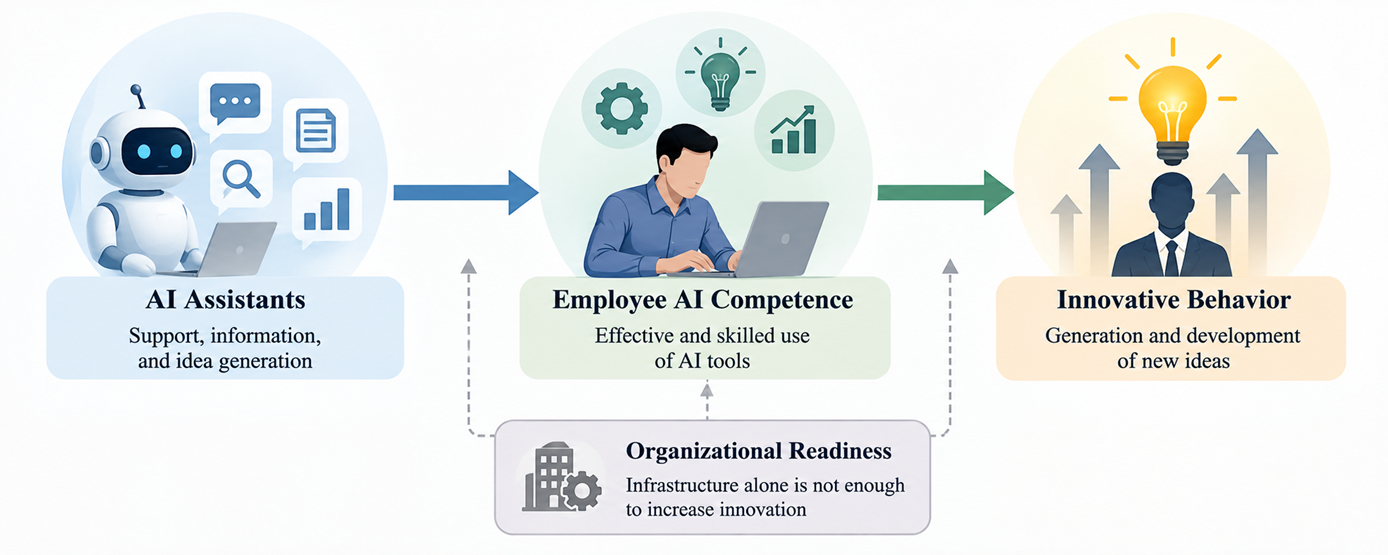
Purpose: This study was conducted to examine the effect of artificial intelligence assistants on the innovative behavior of employees at Amer Andish Hooshmand Company, considering the mediating role of AI competencies and the moderating role of organizational readiness.
Methodology: The research adopted a positivist, causal-comparative approach and was applied in nature. Its statistical population consisted of employees of the knowledge-based company, Amer Andish Hooshmand. Using random convenience sampling and Cochran’s formula, 140 individuals were selected as the sample. The collected data were analyzed using SPSS 27 and SmartPLS software.
Results: The findings show that AI assistants have a positive and significant effect on employees’ innovative behavior. Moreover, AI competency was confirmed as a mediating variable. However, the moderating role of organizational readiness was not confirmed, which may be related to the organization’s infrastructural and cultural limitations.
Discussion: The effectiveness of AI assistants on innovative behavior depends more on employees’ ability to use these tools effectively than on the availability of organizational infrastructure.
Conclusion: Given that the research findings indicate the mediating role of AI competencies in the relationship between AI assistants and innovative behavior, companies should focus on developing AI competencies rather than merely purchasing or deploying AI tools.
Graphical Abstract
Highlights
- AI assistants enhance employees’ innovative behavior.
- Effective AI use strengthens employees’ capacity for innovation.
- AI assistants can help employees generate and develop new ideas.
- Technological infrastructure alone is not enough to foster innovation.
- Employee AI training should complement investment in AI tools.
Keywords
Subjects
Copyright ©, Yaser Ghasemnejad; Mahan Jafarabadi; Abolfazl Ghanbari; Ebrahim Javaheri Zadeh
License
Published by Imam Hossein University. This article is published under the Creative Commons Attribution (CC BY 4.0) licence. Anyone may reproduce, distribute, translate and create derivative works of this article (for both commercial and non-commercial purposes), subject to full attribution to the original publication and authors. The full terms of this licence may be seen at http://creativecommons.org/licences/by/4.0/legalcode