Strategic Management of Organizational Knowledge

Strategic Management of Organizational Knowledge

Ranking the drivers of human resource gaslighting based on knowledge erosion dimensions (Case study: Lorestan University): A combined Delphi, Fuzzy and Marcos approach

Document Type : Original Research Paper

Authors
1 Ph.D. Student, Department of Management, Faculty of Management, Lorestan University, Khorramabad, Iran, s.maryammousavi1375@gmail.com
2 Associate Professor, Department of Management, Faculty of Management, Lorestan University, Khorramabad, Iran, shariat.al@lu.ac.ir
3 Associate Professor, Department of Management, Faculty of Management, Lorestan University, Khorramabad, Iran, arefnezhad.m@lu.ac.ir
4 Professor, Department of Management, Faculty of Management, Lorestan University, Khorramabad, Iran, mousavi.na@lu.ac.ir
Abstract
Purpose: This study aimed to prioritize human resource gaslighting triggers based on knowledge erosion dimensions at Lorestan University.
Methodology: This applied exploratory study employed a mixed-methods approach. Twelve faculty members and staff were selected through purposive sampling based on theoretical saturation. Gaslighting triggers were identified through interviews, screened using the fuzzy Delphi method, and prioritized using the MARCOS method.
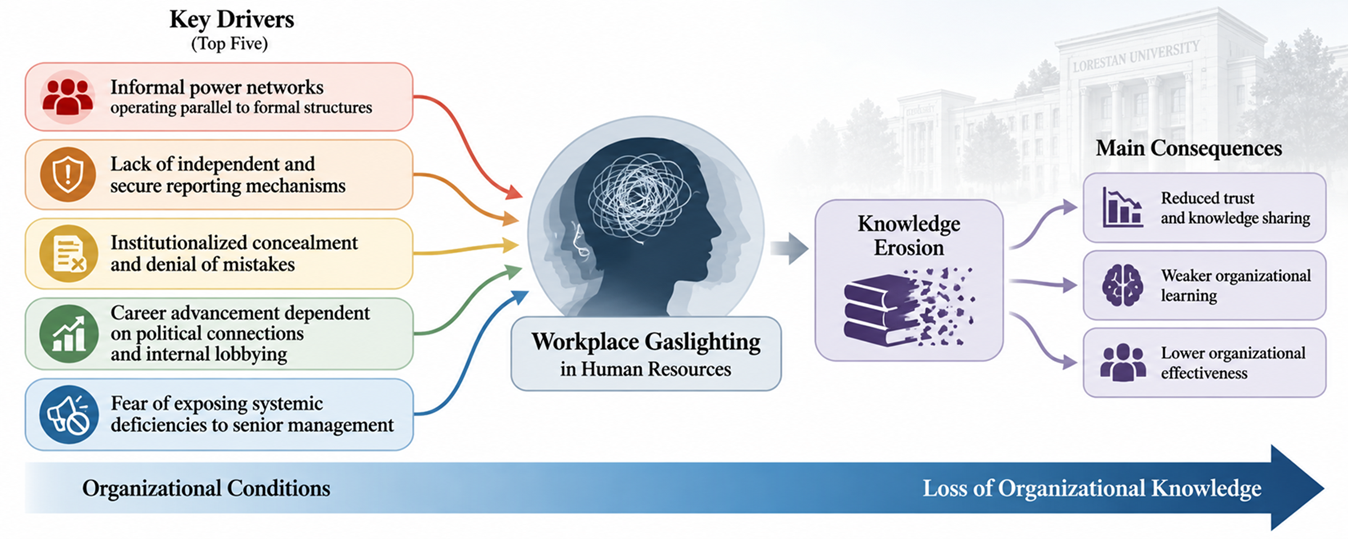
Results: The five highest-ranked triggers were informal power networks operating parallel to formal structures, the absence of independent and secure reporting mechanisms, institutionalized concealment and denial of mistakes, career advancement dependent on political connections and internal lobbying, and fear of exposing systemic deficiencies to senior management.
Discussion: Findings indicate that organizational gaslighting primarily stems from informal power structures, weak institutional accountability, and entrenched secrecy rather than isolated individual behaviors. These conditions contribute to knowledge erosion and undermine organizational learning.
Conclusion: Preventing knowledge erosion requires establishing independent reporting mechanisms, increasing transparency in informal power networks, strengthening institutional accountability, and replacing organizational secrecy with a culture of acknowledging mistakes, corrective actions, and continuous learning.

Graphical Abstract

Ranking the drivers of human resource gaslighting based on knowledge erosion dimensions (Case study: Lorestan University): A combined Delphi, Fuzzy and Marcos approach

Highlights

  1. Hidden power networks are a major source of harmful workplace behavior.
  2. Unsafe reporting systems allow harmful workplace practices to continue.
  3. Covering up mistakes weakens trust and prevents employees from learning.
  4. Political connections in career advancement can undermine workplace fairness.
  5. Transparency and safe reporting can help protect organizational knowledge.

Keywords
Subjects

Copyright ©, Seyedeh Maryam Mousavi Zadeh, Ali Shariatnejad, Mohsen Arefnezhad, Seyede Najmeddin Mousavi

License

Published by Imam Hossein University. This article is published under the Creative Commons Attribution (CC BY 4.0) licence.Anyone may reproduce, distribute, translate and create derivative works of this article (for both commercial and non-commercial purposes), subject to full attribution to the original publication and authors. The full terms of this licence may be seen at http://creativecommons.org/licences/by/4.0/legalcode 

Alavi, M., & Leidner, D. E. (2001). Knowledge management and knowledge management systems: Conceptual foundations and research issues. MIS Quarterly, 25(1), 107-136. https://doi.org/10.2307/3250961
Argote, L., & Miron-Spektor, E. (2011). Organizational learning: From experience to knowledge. Organization Science, 22(5), 1123-1137. https://doi.org/10.1287/orsc.1100.0621
Ashraf, S. (2024). Investigating the antecedents and consequences of workplace gaslighting: Interdependence theory and affective events theory perspectives.
Bamdad soofi, J., Taghavifard, M. T. and Arjmand ghahestani, O. (2017). A Framework for risk analysis of knowledge loss caused by knowledge workers Departure. Management Studies in Development and Evolution, 25(82), 29-59. doi: 10.22054/jmsd.2017.7146 (In persian)
Černe, M., Nerstad, C. G. L., Dysvik, A., & Škerlavaj, M. (2014). What goes around comes around: Knowledge hiding, perceived motivational climate, and creativity. Academy of Management Journal, 57(1), 172-192. https://doi.org/10.5465/amj.2012.0122
Crouch, C. (2015). The knowledge corrupters: Hidden consequences of the financial takeover of public life. Polity Press.
Ebrahimi, E. (2025). Understanding the Phenomenon of Gaslighting in Organizational Context: A Descriptive Phenomenological Approach. Organizational Culture Management, 23(4), 373-388. https://doi.org/10.22059/jomc.2025.387640.1008749 (In Persian)
Fielding-Singh, P., & Dmowska, A. (2022). Obstetric gaslighting and the denial of mothers’ realities. Social Science & Medicine, 301, 114938. https://doi.org/10.1016/j.socscimed.2022.114938
Graves, C. G., & Spencer, L. G. (2022). Rethinking the rhetorical epistemics of gaslighting. Communication Theory, 32(1), 48-67. https://doi.org/10.1093/ct/qtab013
Habibi, A., Jahantigh, F., & Sarafrazi, A. (2015). Fuzzy Delphi technique for forecasting and screening items. Asian Journal of Research in Business Economics and Management, 5(2), 130-143. https://doi.org/10.5958/2249-7307.2015.00036.5  
Harvard Business School Working Knowledge. (2005). Can an organization's 'deep smarts' be preserved?
Javaherizade, E., Ghasemi Banabari, F., Sadeghi, F. & Maleki, M. H. (2025). Ranking the factors influencing talent recruitment in startup companies using Fuzzy Delphi and Marcos approaches. Organizational Resources Management Researches, 15(2), 73-101. doi: 10.48311/ormr.2025.27575 (In persian)
Jones, S. S. (2023). Gaslighting and dispelling: Experiences of non-governmental organization workers in navigating gendered corruption. Human Relations, 76(6), 901-925. https://doi.org/10.1177/00187267221083274 
Kariuki, C. G. (2025). The Silent Agony: A Comprehensive Analysis of Covert Bullying, Legal Frameworks, and Mental Health Decline in the Modern Workplace. International Journal of Advanced Research.
Katsiroumpa, A., Moisoglou, I., Konstantakopoulou, O., Tsiachri, M., Kolisiati, A., & Galanis, P. (2025). The gaslighting at work scale: Development and initial validation. Journal of Workplace Behavioral Health, 1-23. https://doi.org/10.21203/rs.3.rs-5791246/v1
Kincaid, P. A., Reger, R. K., Kidwell, V. L., & Neumann, C. (2023). Gaslighting: The Dark Side of Trust in Organizations. In Academy of Management Proceedings (Vol. 2023, No. 1, p. 12217). Briarcliff Manor, NY 10510: Academy of Management. https://doi.org/10.5465/AMPROC.2023.12217abstract
Kukreja, P., & Pandey, J. (2023). Workplace gaslighting: Conceptualization, development, and validation of a scale. Frontiers in Psychology, 14, 1099485. https://doi.org/10.3389/fpsyg.2023.1099485
Landis, J. R., & Koch, G. G. (1977). The measurement of observer agreement for categorical data. Biometrics, 33(1), 159-174. https://doi.org/10.2307/2529310
Legacy, C. (2025). On Transformation and Gaslighting. Planning Theory & Practice, 26(4), 477-480. https://doi.org/10.1080/14649357.2025.2580151
Levy, D. L. (2011). Knowledge retention: Minimizing organizational business loss. Journal of Knowledge Management, 15(4), 647-661. https://doi.org/10.1108/13673271111151974
Massingham, P. (2022). Knowledge risk management: From theory to practice. Springer.
Naheedy, D. (2025). When Doubt Is Manufactured: Gaslighting in Clinical Laboratory Settings. ASCLS Today, 39(5). https://ascls.org/when-doubt-is-manufactured-gaslighting-in-clinical-laboratory-settings/
Ogunfowora, B., Guenther, K., & Bourdage, J. (2023). On the Structure and Nomological Network of Gaslighting in the Workplace-A Leadership Perspective. In Academy Of Management Proceedings, 1(19012), Briarcliff Manor, NY 10510: Academy of Management. https://doi.org/10.5465/AMPROC.2023.19012abstract
Park, Y., & Lee, S. (2025). The Impact of Workplace Gaslighting on Employees’ Mental Health: The Mediating Role of Basic Psychological Needs Satisfaction. Korean Journal of Health Psychology, 30(6), 1107-1125. https://doi.org/10.17315/kjhp.2025.30.6.006
Sarkar, Q. (2024). From tolerance to transformation: unraveling the impact of organizational culture and policies on addressing gaslighting in academia. International Journal of Innovation in Teaching and Learning (IJITL), 10(1), 22-39. https://doi.org/10.35993/ijitl.v10i1.3041
Sharma, R. (2025). How Corporate Gaslighting Destroys Careers. HRKatha. https://www.hrkatha.com/features/how-corporate-gaslighting-destroys-careers/
Stanković, M., Stević, Ž., Das, D. K., Subotić, M., & Pamučar, D. (2020). A new fuzzy MARCOS method for road traffic risk analysis. Mathematics, 8(3), 457. https://doi.org/10.3390/math8030457
Viale, R., & Coletta, C. (2019). Knowledge erosion and knowledge degradation: A conceptual framework. VU Research Repository.
Westover, J. H. (2025). Identifying and Addressing Gaslighting Behavior in the Workplace. Innovative Human Capital. https://www.innovativehumancapital.com/article/identifying-and-addressing-gaslighting-behavior-in-the-workplace
Yasini, A., Adinehvand, M. and Kabiri Yeganeh, M. (2025). Understanding the Phenomenon of Gaslighting in Organizational Relationships. Public Organizations Management, 13(2), 67-90. https://doi.org/10.30473/ipom.2025.72844.5073 (In Persian)